Spanish Civil War
For African Americans who had sympathized with or joined the US Communist Party — the only institution that offered a multiethnic agenda — the war in Spain was more than an opportunity to oppose international fascism. It was a chance to avenge Mussolini's 1935 attack on Ethiopia, which stood as a symbol of ethnic purity and resistance against external occupation.
For Black communities across the United States, the news of Black Americans in Spain was shaped decisively by the poet Langston Hughes, who was sent to cover the war for the Baltimore Afro-American. His journalism was the first homage to African Americans who fought in the Spanish war, highlighting the soldiers of the Abraham Lincoln Battalion, one of several units that made up the XV International Brigade. [1] He also wrote about meeting Salaria Kea (1913–1991), a Black nurse from Ohio who came to Spain to support the fight against fascism.
Cafe de l'Opera

Wikimedia Commons · CC BY-SA

Cafe de l'Opera interior · Travel Between the Pages
Langston Hughes (1901–1967), American author and poet, first arrived in Barcelona in July 1937 as a war correspondent for the Baltimore Afro-American and visited the cafe to socialize and write. His extensive body of work includes poems written in 1936 and 1937 about the Spanish Civil War.
La Rambla

Wikimedia Commons · CC BY-SA
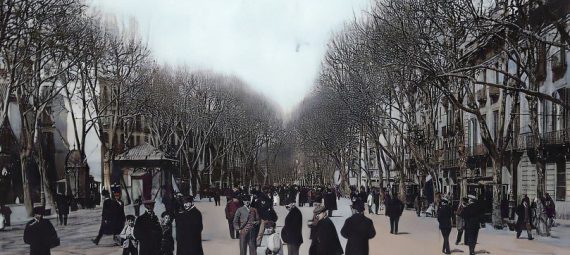
La Rambla de Santa Mònica · La Barcelona de Antes
Follow in the footsteps of Langston Hughes and Nicolás Guillén (1902–1989), an Afro-Cuban poet who wrote explicitly on the Spanish Civil War and Black internationalism.
During a stay in July 1937, the two lodged at the Hotel Continental on La Rambla, a large hotel that had once catered to tourists and housed journalists and foreign observers. Hughes moved through the city largely on foot, spending time along La Rambla and in the area then-known as Barri Xines — today's El Raval.
Hotel Continental (now Primark)
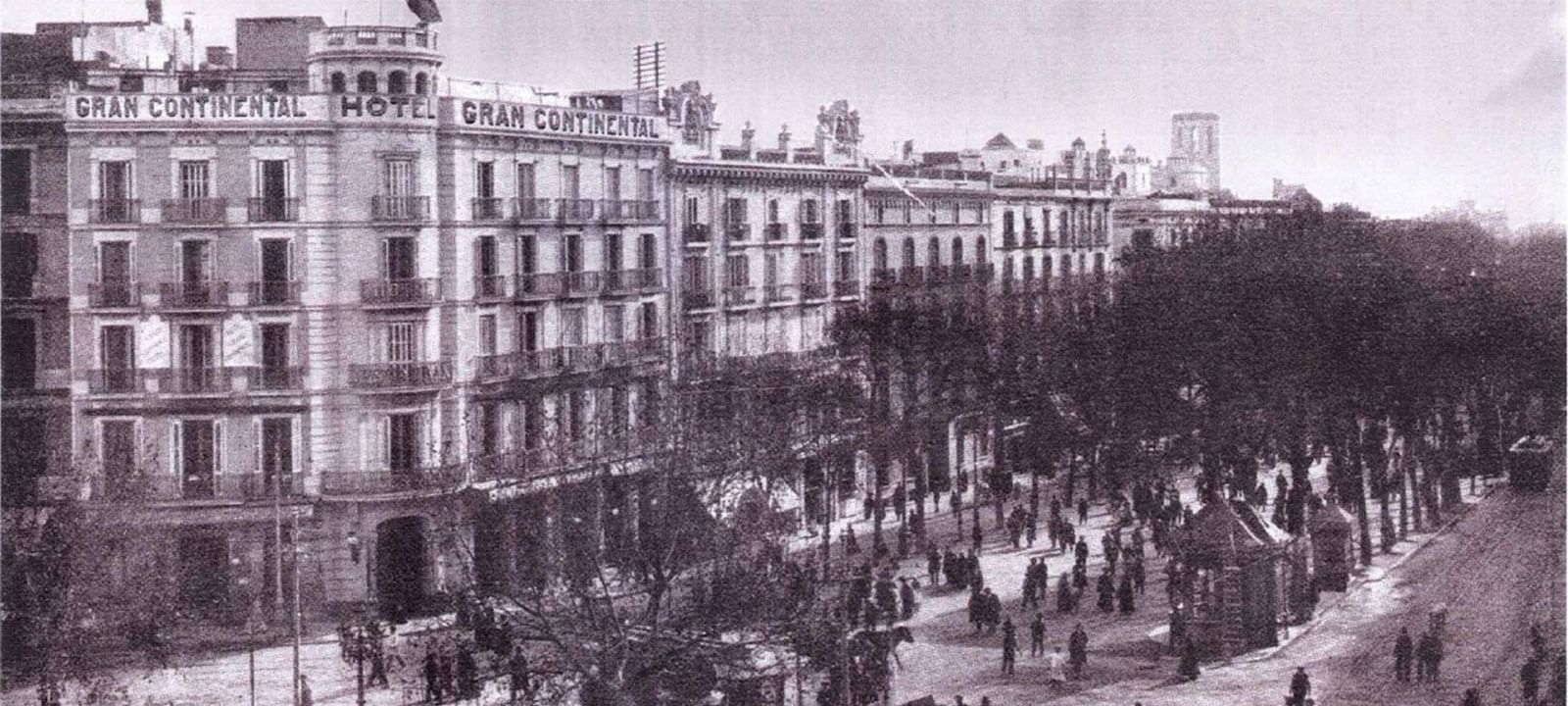
Hotel Continental, La Rambla · c. 1916
Langston Hughes and Nicolás Guillén stayed here in July 1937 during a bombing campaign. As Hughes reported in the Baltimore Afro-American:
"I had just barely gotten to my room and had begun to undress when the low extended wail of the siren began, letting us know that the fascist planes were coming. (They come from Mallorca across the sea at a terrific speed, drop their bombs, and circle away into the night again.)Quickly, I put on my shirt, passed Guillén's room, and together we started downstairs. Suddenly all the lights went out in the hotel, but we heard people rushing down the halls and stairways in the dark. A few had flashlights with them to find the way. Some were visibly frightened.
In the lobby two candles were burning, casting weird, giantlike shadows on the walls. In an ever increasing wail the siren sounded louder and louder, droning its deathly warning. Suddenly it stopped. By then the lobby was full of people, men, women, and children, speaking in Spanish, English, and French. In the distance we heard a series of quick explosives.wrote about being awakened twice by the air raid guns when bombing aircraft were flying around Barcelona.”