Post-War Intellectuals
Between 1945–1955, Francisco Franco managed to remake his image abroad. No longer an ally of the WWII Axis, he repackaged himself as a stalwart anti-communist, ruling over a strategic country at the crossroads of Africa and Europe.
Although Franco was considered an illegitimate ruler by U.S. President Franklin Roosevelt, he became a crucial partner in the battle between freedom and communism for Presidents Truman and Eisenhower. Those presidents helped end the Franco regime’s post-WWII diplomatic isolation. In exchange, the U.S. built Cold War military bases in Spain. As the Spanish Civil War came to be viewed through the retrospective lens of the Cold War, the previous generation of Americans who fought with the communists against the fascists would come to be viewed with suspicion as agitators.
MACBA
.jpg?width=1200)
Wikimedia Commons · CC BY-SA
As was evident during the transatlantic slave trade, wealthy, well-connected institutions have a large impact on shaping the fortunes of people around the world. With a global reach made more immediate by the internet, today's institutions potentially have an even greater responsibility than previous ones in educating the public on justice and narrative, and in providing opportunities for marginalized voices to be heard.
CCCB

Façana exterior

Pati de les Dones
CCCB, Gunnar Knechtel, 2023 · CC BY-NC-SA
These museums often host speaker events, exhibitions, and debates featuring people from the African diaspora and allies. Recent guests have included Chimamanda Ngozi Adichie, NoViolet Bulawayo, Angela Davis, Ngũgĩ wa Thiong'o, Lilian Thuram, and Colson Whitehead.
Richard Wright

Wikimedia Commons · Public domain
Richard Wright (1908–1960) drove into Spain from France in 1954. After passing through the Catalan countryside, he arrived in Barcelona, was taken to the cathedral, and stayed in a pension in "the center of the city." As he wrote in Pagan Spain (1957), the "aspect of early-morning Barcelona that impressed me most next day was the strident quality of its noise, lifting that city into a class of the noisest cities on earth."
However, he also had a contradictory experience noting that he "reached a street corner and found my path blocked: a vast flock of sheep was ambling down the broad, modern avenue. I stared, doubting my eyes. Yet, there they were, mincing along slowly in the center of the city, occasionally bleating. A boy with a long staff was leading them. I watched them until they were out of sight, then I became aware of the pavement vibrating under my feet from the rushing force of a subway train. Barcelona was so sophisticated that one was likely to see anything."
He is believed to have interacted with various locals, including writers, in Raval. He also spent time on La Rambla and attended a bullfight at Monumental. His portrayal of Spain is one as "deeply backward, profoundly poor, and utterly static, with no prospects for change." Although Franco’s regime is the most likely reason, Wright "analyzes Franco as more of a symptom than a cause. The problem, in his view, is spiritual: the Spanish people are deeply irrational, hierarchical, communalistic, and superstitious."
James Baldwin

Allan Warren · CC BY-SA
James Baldwin (1924–1987) traveled to Spain for the first time in 1953. During that trip, he met poet Jaime Gil de Biedma and stayed in his basement on Carrer Muntaner, which he called "blacker than my reputation." They spent seven days together moving around the city, including the picnic areas on Montjuïc. In a 1984 interview, "Baldwin explained that on that occasion he visited Barcelona, Bilbao, and San Sebastian, he did not stay long in the country 'because of the uniforms, the uniforms of the police and the Civil Guard. I’ve been scared of the police since I was a child. I lived in Harlem.'"
On subsequent trips in the early 1960s, Baldwin became acquainted with important members of the Barcelona literary scene, such as publishers Carlos Barral and Jaime Salinas, critic Josep Maria Castellet, and poet Gabriel Ferrater, who also translated Nobody Knows My Name. These young intellectuals were part of a group which played a pivotal role in the transformation of Spanish literature from the late 1950s onward."
End: Universitat de Barcelona
Toni Morrison (1931–2019) was an American novelist, editor, and Nobel Prize recipient. Born seven years after James Baldwin, the two first met in the 1970s and became friends who read each other's work. Before his death, Baldwin stated "Toni’s my ally and it’s really probably too complex to get into. She’s a black woman writer, which in the public domain makes it more difficult to talk about...Her gift is in allegory." After Baldwin's passing, Morrison thanked him "for three gifts: his language, his courage, and his tenderness."
In turn, after Baldwin's passing, Morrison thanked him "for three gifts: his language, his courage, and his tenderness. Baldwin, she noted, was a beloved friend who had 'un-gated' American English in ways that made her own miraculous career possible."
The university's Lletra de Dona archives hosts work by her. It is also believed that she lectured here in 1991.

Wikimedia Commons · CC BY-SA

Allan Warren · CC BY-SA
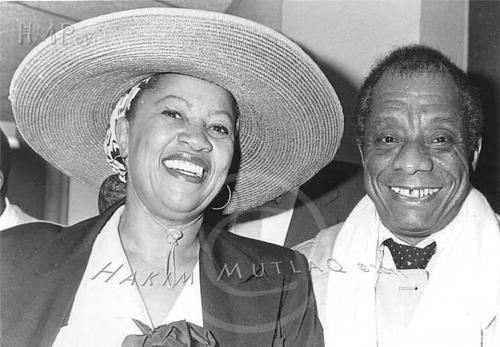
Morrison & Baldwin photo sourced from Buala. All others from Wikimedia Commons.